Thursday, February 7, 2019

III. BORDER TUNNEL PROBLEMS
Following are photos of tunnels that were dug beneath the Mexico-U.S. border from around 2006-2007.  Some have not yet been sealed on the Mexican side.  These are located in the San Diego area.  From DEA.
The difficult tunnels to detect are those from building to building dug beneath other structures in urban areas.  In these areas, surveillance and intelligence collection have produced some discoveries.


A hardened tunnel from Gaza into Israel and military items found in it.
Israeli SDF has some new technologies to discover tunnels while under construction.   I think it probably has to do with oil exploration tech that uses explosive sounds and recorded on a seismograph and listening devices.
Captain B, an IDF officer trained in electrical engineering and chemistry, runs the laboratory where physicists, engineers, intelligence personnel and geologists work. “What happens is the soldiers scan the fields and bring us the data,” a soldier who works in the laboratory said. “From the data, we can extract all kinds of graphs. We decipher them and search for things that look like changes or disruptions in the ground. That’s really how we find a tunnel.”

Text Box: The Nexus between terrorism and drug cartels has often been reported.  Although the goal ot the terrorist is to overthrow a government, Crime cartels are conservative working within the system.  At times, they appear to cooperate in transnational crime such as smuggling.    Featured image courtesy of ICE.
The Israeli Defense Force (IDF) recently destroyed a kilometer long tunnel built by the Hamas running from the Gaza Strip under the border several hundred yards into Israel, IDF sources confirmed on Sunday. Destroying the tunnels was a primary objective of Israeli forces in the 2014 Israel–Gaza conflict.  This tunnel was detected during construction representing a breakthrough in technology.
Cross-border tunnels were used in the capture of Gilad Shalit in 2006, and multiple times during the 2014 war with Hamas. Palestinian militants routinely crossed the border through the tunnels to attack IDF soldiers. The IDF claims that it neutralized 32 tunnels, 14 of which crossed into Israel. Hamas developed a sophisticated network of military tunnels beneath many Gaza towns and cities and the Shati refugee camp.  Hamas uses the tunnels to hide its arsenal of rockets underground and conceal fighters making attack from the air problematic.
What is new about this story is that an Israeli spokesman, LTC Conricus, said that Israel had used a new set of tools to destroy the tunnel. Israeli forces detected the tunnel months ago and monitored its construction. This provided further intelligence and caused the waste of hard work and resources by Hamas terrorists. While not specified by the spokesman, military tactics dictate timing the destruction of the tunnel to destroy as many of the engineers as possible. Killing terrorists is easy, but they are easy to replace. Tunnel engineers are rare and uniquely dangerous.
The spokesman said the timing of this operation was not connected to the violence following President Trump’s recognition of Jerusalem as Israel’s capital.  Hamas, which controls Gaza, declined to comment.
The tunnel entrance was in the town of Khan Younis inside the Gaza Strip and ran for half a mile across the border into Israel. Destroyed before completion, the tunnel was equipped with lighting, communications equipment and ventilation. The end of the tunnel was located a kilometer from an Israeli civilian community.
 The Department of Homeland Security has their own Departmen of Science & Technology that is working on several programs to
Text Box: Sandia Labs in New Mexico has been conducting research for some years on better ways to detect tunnel construction.  In terms too difficult for me, such as the Biot-Gassmann theory used by oil explorers and it seems that some progress has been made; and that there are promising developments on the way.Photo courtesy of DHS.
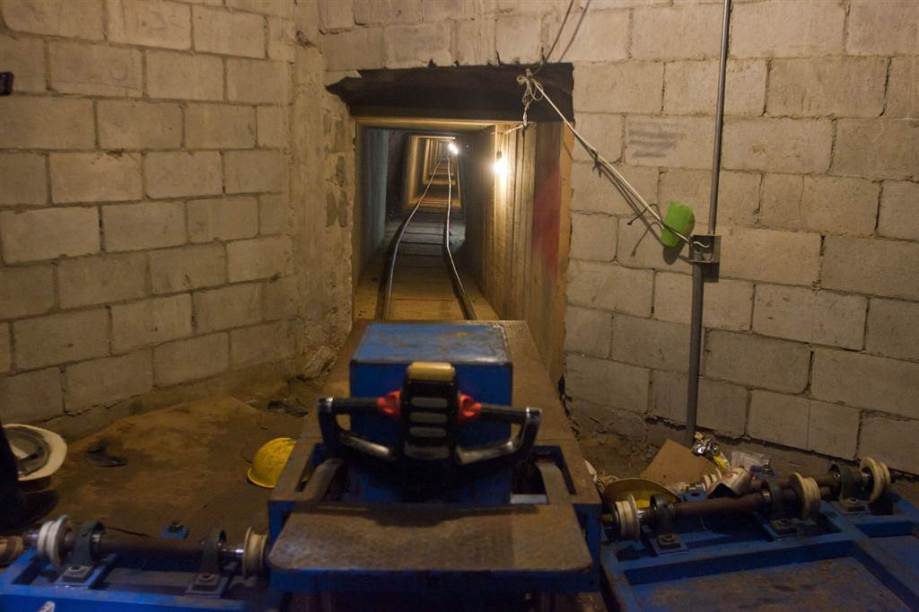
These tunnels are very similar to tunnels used by Mexican drug cartels. They are typically 80 feet below ground and half a mile long. This makes them impossible to locate using ground penetrating radar or other technology due to underground clutter masking the tunnel’s signature. They normally run from a house or business in Mexico and exit inside a building in the US.
These cross-border drug tunnels built by a drug cartel and interdicted by Homeland Security Investigations. You can see that these tunnels are well constructed with drainage pumps, lights and ventilation systems. Most have some type of rail system to facilitate movement.
There are going to be functional similarities between any two tunnels but it’s possible that there is a deeper connection. Israel and Mexico have conducted joint operations against Hamas inside Mexico. The arrival of active Hamas operatives in the early 2000s coincided with increased Iranian force projection (Hamas is very closely connected with Iran). Shortly after the arrival of Hamas in Mexico, U.S. authorities began seeing new developments: vehicles used as bomb delivery devices, decapitations and tunnel construction.
It is possible that Hamas tunnel engineers have worked with the Mexican cartels transferring their experience. Mexican tunnels are precisely navigated and well-constructed. The engineering challenges of moving thousands of tons of dirt are staggering. Most of the cross border tunnels were dug in the clay soil of San Ysidro, California. Clay dries out to form a self-shoring structure but large areas need to be braced to prevent collapse. This requires calculation.
A typical drug tunnel has finished construction work throughout. Lights, ventilation and drainage may seem like luxuries, but they are basic requirements which must be engineered. Ignorance of the underground environment can kill the novice tunnel builder in many ways.
In a tunnel, there is complete darkness. Portable lights lack the endurance for construction and maintenance. There is no air flow in a tunnel. This means that by breathing, oxygen is depleted and not replaced. Rusting iron will bind oxygen. Gasses can also seep from the earth of the tunnel. This results in areas that will not support human life. Undetectable without instruments, these areas kill without warning. If an engineer digs a hole below the water table, it will fill with water. Constant drainage is necessary. Water degrades structural integrity, making things even more dangerous.
Hamas has publicly threatened to extend their war against Israel into the United States. Many analysts in the intelligence community believe that Hamas are conducting operations in Mexico because illegal immigration and drug trafficking networks provide the most effective way to move people and equipment into the U.S. Hamas may already have sleeper cells operating in Mexico.
This new Israeli breakthrough in tunnel detection and exploitation is great news. It is entirely possible that American intelligence is sharing information. The lack of reports of recent Mexican cross border tunnels may well be connected to this story.
https://thenewsrep.com/95738/israeli-army-displays-new-tunnel-detection-technology-hamas-terror-tunnel-terminated/.
Mark Miller is a Green Beret who served in Afghanistan and a number of other live fire locations. He's a poet-warrior in the classic sense, a casual hero and a student of science.
Tunnels have been dug for prison escapes for centuries’.  Some were made material for successful movies such as The Great Escape (Allied POWs in Stalag Luft III during WWII   others, even as dramatic but virtually unknown include a tunnel from a Holocaust Death Camp in Lithuania that was dug with bare hands and spoons.  More recently was the tunneling IN to a prison to free Mexican Drug Kingpin El Chapo.  One has to remember that projects such as these are made easier through bribery of those in control.
The human mind is capable of analyzing a situation and problem and developing a plan to overcome most obstacles.  During my war experience, I came across some rather ingenious methods used by the Viet Cong to move supplies and people – both VC and NVA through a well-developed trail/cave system in the southern part of Vietnam.  Due to the nature of terrain in the Mekong Delta (low-lying flood zone) extensive tunnels were not used although underground caches were discovered in concrete-lined areas.  Some of these were discovered by soldiers walking around sticking their cleaning rods into the soft ground of the Delta.  
There were even more extensive tunneling projects in other parts of that country, several beneath U.S. military facilities.  Some were discovered by driving heavily-laden trucks around, collapsing some of the tunnels.

In our area, we employed various types of sensors to detect movements between their more secure areas – mostly caves in the few hills there were in the Delta and in areas of Mangrove swamps and patches of forest.  We had varying degrees of success with sensors and surveillance equipment.  Improved models of this equipment are employed by our border security forces today.   


 Lou

II. DO BORDER WALLS WORK?

II. DO BORDER WALLS WORK?  If not, why are 65 countries building them?

Currently, politicians are arguing over a project that initially needs about six billion dollars.   This is about .08 of a percent of the U.S. budget.  That is not a large percentage of spending for upgrading access denial that would save money in the long term as well as improve security. It is not enough to seal the border but it will allow the denial of access of many to areas between and near ports of entry (POEs).  That allows better use of limited human resources and would actually save the lives of those who cross into hostile areas.

I have often heard the argument that walls don’t work as they can be tunneled under or simply flown over, or just take the water route in an end run.  Tunneling under borders has occurred for centuries.   Now there is more sophisticated equipment to detect tunneling, water routes are patrolled with more sophisticated radars and aircraft, and the use of these routes have subsided significantly.

The wall/fences work by funneling people to POEs that are located in border population centers.  At these points, those who cross are exposed to the most effective detection equipment that has proven effective intercepting large quantities of drugs, usually hidden in vehicles.  These are usually under some control of Drug Cartels. 

In the less populated areas, there are some older fences that may stop vehicular traffic but not people on foot.   We have no firm figure on how many do this, only numbers of those caught.  As more states legalize substances such as Marijuana, traffickers have moved into stronger man-made drugs such as fentanyl and into human trafficking.   

What is not generally known is that there are several hundred miles of our southern border without physical barriers.   Simply a cattle-type fence and occasional signs to warn people of the border and possible smuggling are common.  Friends living in the area have stated the situation in Cochise County has improved greatly in recent months.


T
The Huachuca Mountains allow access from Mexico right into Fort Huachuca and national forest lands.  It is difficult terrain and not many choose this route.  Other areas of the border are in the desert land, a harsh environment that has claimed many lives from exposure, thirst, and hunger. 

The NGO Border Angels estimate that since 1994, about 10,000 people have died in their attempt to cross the border.[3] According to the U.S. Customs and Border Protection, 7,216 people have died crossing the U.S–Mexico border between 1998 and 2017, mostly from exposure dehydration and hyperthermia. 

I have not heard this large number of migrant deaths discussed in current arguments.   I do know that many of these lives could have been spared if we had adequate border fencing and wall to keep migrants from crossing into environmentally hostile areas. 
I would like to present some information into what a large number of countries feel about border security. 
65 countries of the world have erected some form of border security barriers.  Several countries have erected more than one.   They must find some value in spending money on walls and fences

As a former intelligence and security guy, I worry more than a little about the facts that smuggling drugs and migrants can also smuggle terrorists (and has) and that the Coyote/Crime Cartel operations are two way.  A Fast and Furious gun showed up in Morocco.  At the present time, Latin America is the most violent area of the world. It suffers 33% of the world’s homicides despite having only 8% of its population. One-quarter of all global homicides are concentrated in four countries – Brazil, Colombia, Mexico, and Venezuela.  In Latin America, one-third of the people have been victims of violent crime and in Mexico, over one half of the population has suffered a violent crime within a family.  Many of the current migrants are victims of crime or are trying to avoid it but there are also convicted criminals in their homeland who feel they can do better in the U.S. with a fresh start.   

There really is a need for some type of immigration reform that is aimed at stopping these repeat offenders – something to separate them from those not committed to a life of crime or members of a cartel or gang. 

Although border walls have been effective at some points in the U.S., more than half the border is open.   These areas are mostly in desert-like conditions and many deaths have occurred from exposure. In Europe, where walls have been built to keep out mass migrations, groups have taken to the sea to cross borders and this also results in deaths by drowning.  The obvious path is to reduce the magnetism that sparks mass migrations.  But the problem in the U.S. is much more than migrations.   It involves Transnational Organized Crime and all its bad effects on our society.  There are other downsides as well but these are up to our elected officials to come up with legislative reform that most people can live with.   They seem unwilling or not up to the task.

 
Not all border walls have been called successful.   The Great Wall of China of 13,000 miles was never one wall but many built by kingdoms to prevent nomadic tribe raids it helped to control movements and control commerce, collect taxes and control movements. It is now producing revenue from tourism.  Not unlike the European experiences with walled cities as tourist sites.  When people moved from city-states to countries with borders agreed to by others, the walls became unnecessary.  However after 9/11, and ease of movement around the globe, many countries began rethinking security with new walls along international boundaries...

In the U.S., the first border upgrades of any significance were under Operation Gatekeeper.  It came into play during the Clinton administration in 1994 and built just less than 6 miles of strong fencing and other measures between San Diego and Tijuana.

The measure carried out by the U.S. Border Patrol of the Immigration and Naturalization Service (INS)), was aimed at halting illegal immigration to the United States at the United States–Mexico border near San Diego, California.[1] According to the INS, the goal of Gatekeeper was "to restore integrity and safety to the nation's busiest border." Congress approved the money for implementation.

By 1997, the budget of the Immigration and Naturalization Service had doubled to 800 million dollars, the number of Border Patrol agents had nearly doubled, the amount of fencing or other barriers more than doubled, and the number of underground sensors nearly tripled.   In a later phase, biometric identification was added.

The merits of Operation Gatekeeper were debated extensively, including during Congressional hearings. The Department of Justice, the INS, and the Border Patrol maintained that Operation Gatekeeper was a success. Some Congressmen and others sharply criticized the program. 

In May 1995, the Border Patrol initiated Operation Disruption to target human smugglers, and also established new checkpoints on interior highways and apprehensions increased.  The first Immigration Court was set up at the San Ysidro POE that expedited Immigration Court hearings, deportations of those with or with false documents.  

Phase two also introduced IDENT, an automated biometric identification system, to facilitate identification of repeat offenders and "criminal aliens", i.e., illegal immigrants with criminal records or active warrants for their arrest.

The tighter controls at the busy checkpoint sent illegals to passage over the Otay Mountains to the east that did not have upgraded border walls.   The death rate climbed.
A more extensive wall/fence system might have prevented many immigrant deaths.

To operate our border security measures, we have the U.S. Customs and Border Protection, a part of the Department of Homeland Security.

CBP Mission from their website.

“CBP’s top priority is to keep terrorists and their weapons from entering the U.S. while welcoming all legitimate travelers and commerce. CBP officers and agents enforce all applicable U.S. laws, including illegal immigration, narcotics smuggling, and illegal importation. CBP deploys highly trained law enforcement personnel who apprehend more than 1,000 individuals each day for suspected violations of U.S. laws.
CBP's border security mission is led at ports of entry by CBP officers from the Office of Field Operations, along with U.S. borders by agents from the United States Border Patrol and from the air and sea by agents from Air and Marine Operations. Also at ports of entry, agriculture specialists are deployed to protect U.S. agriculture from the introduction of pests or disease from overseas sources.”

Saving Lives
CBP and other agencies are also involved in saving lives.  This is not often covered in the news.  The demographics of our border agents are interesting.   About 52% of the operating force is of Hispanic descent and a large number of them had parents who were recent legal immigrants but most are from families that have been present for generations. They do what they can to save lives. U.S. Border Patrol reported that 3,221 migrants were rescued in the fiscal year 2017.[4] (Wikipedia)
Migrant deaths along the Mexico–U.S. border
The sadder statistics around are the many deaths that occur as people find weak spots in border security, cross the border illegally,  and enter hostile environments.

The US Border Patrol reported 294 migrant deaths in the fiscal year 2017 (ending September 30, 2017), which was lower than in 2016 (322), and any year during the period 2003-2014. Exposure (including heat stroke, dehydration, and hyperthermia) were the leading cause of these deaths.[2]

The group Border Angels estimates that since 1994, about 10,000 people have died in their attempt to cross the border...[3] According to the U.S. Customs and Border Protection, 7,216 people have died crossing the U.S–Mexico border between 1998 and 2017.[4] In 2005, more than 500 died across the entire U.S.–Mexico border.[5] The number of yearly border crossing deaths doubled from 1995 to 2005, before declining.[6] The statistics reflect only known deaths and do not include those who have never been found.[7]

Mexico's Secretariat of Foreign Affairs has compiled data including deaths on the Mexican side of the border area during the period from 1994 to 2000. The data shows 87 deaths in 1996, 149 in 1997, 329 in 1998, 358 in 1999, and 499 in 2000

Two examples of successful border walls (although controversial) include: 

The first is from Israel. The graph clearly depicts the effectiveness of their border
More details can be found at:

The U.S. Senate report is worth reading for those with an interest in security in general.  It also contains information on Aviation Security, Cybersecurity, POE operations,

and dollar costs.  One has to keep in mind is that border walls are the difference between life and death to Israel

A Slate magazine article basically states the fences work. The Israeli fence is very efficient. The number of fatalities from terror attacks within Israel dropped from more than 130

The second is from Hungary.  The country reduced illegal immigrants from entering by 99%,
Hungary decided to move against the EU open borders policy in that they discovered that many of the illegal immigrants were not simply fleeing war.  The country had a spike in criminality and terrorist attacks.  They decided to build a wall at its border with Serbia, Croatia and Slovenia while refusing to take in its Brussels-imposed “quota” of immigrants. 

This wall apparently does its job.  Illegal immigration collapsed from just under 400,000 in 2015 to less than 20,000 in 2016 and only 1184 in 2017.   Most of those were from Romania.  Statistics were from Hungary’s Chief Security Advisor Gyorgy Bakondi. 

The advisor further stated that the system of technical barriers is the key to the success of border security.

Without it, illegal immigration would be impossible to stop the mass arrival of immigrants” https://www.theissue.com/politics/hungarys-border-wall-reduced-illegal-immigration-by-99-percent.

A current estimate is that about one-third of our border with Mexico has some form of working wall or barrier fence.  About half of that needs major upgrading.  Existing walls have been successful at funneling border crossers to Points of Entry (POE) control points to use some new and sophisticated equipment to make some rather large drug and human interceptions.  Some correctly state that POEs are where most drugs enter the U.S.  This is the preferred method used by Cartels as more can be carried in a vehicle than on foot.  But there are many people crossing weak border areas with packs on their backs containing drugs.  The border patrol believes they only catch 10-15% of illegal border crossers.    But in reality, we have only estimates as to how many people and drugs cross into the U.S. from Mexico.  What is interesting is that in some areas, more illegals are apprehended at highway checkpoints some miles to the interior of the U.S. than directly at the border.  These were started with Operation Gatekeeper.

There are other reports and statistics that provide answers to the question: DO BORDER WALLS WORK? They do work.  Some work very well, others like the U.S.-Mexico Border Wall/Fence are only partially adequate. Border Patrol agents need a physical barrier that provides a containment function to keep the flood of illegal aliens at bay. This enables the agents to focus on highly risky locations and apprehend enough border-crossers to not lose the battle altogether.

Border walls and fences have been used for centuries for several reasons.  The first was
the defense against critters and aggressors?  Fortifications often included entire cities as can be seen today throughout Europe.  Early settlers in the U.S. had as priority #1, Water and #2, building a wall or fort as there were folks out there who didn’t want them there. Now, border walls are primarily used to prevent smuggling.  People, drugs, weapons, and most recently, mass migrations.


In the Indus Valley village of Kot Jiji, there are walls from 3500 B, C, E,  At the West Bank town of Jericho, one can see remnants of an extensive wall from the 8th Millennium B.C.E.  There apparently were few politicians in those days that fought over a need for defenses.  In the days of City-States, castles and walled cities were used for centuries.  But when firm borders were established for countries and recognized by others,, they were no longer needed.  So the walls we see under construction around the world are fairly new phenomena in response to mass migrations and TOC.


Lou